

Define Buyer Segments and Willingness to Pay
This section outlines segment identification and willingness to pay.
It guides mapping personas to top value drivers.
It explains revenue assessment and feature prioritization.
Identify Buyer Segments
Start by grouping buyers with similar needs and purchase behaviors.
Next differentiate segments by their primary problems and desired outcomes.
Additionally consider purchase context and decision authority within organizations.
Also note adoption readiness and budget constraints for each group.
Map Personas to Top Value Drivers
Create concise persona profiles that capture motivations and success criteria.
Then align each persona with their most important product benefits.
Furthermore summarize the top value drivers that influence buying decisions.
- Role or title within the buyer’s organization.
- Primary goals and desired outcomes.
- Key pain points or obstacles to adoption.
- Most influential value drivers for purchasing decisions.
- Typical buying triggers and timing considerations.
- Budget ownership and pricing sensitivity indicators.
Estimate Willingness to Pay
Translate value drivers into monetizable outcomes that buyers care about.
Then develop hypotheses about price sensitivity for each persona.
Additionally compare perceived value against existing alternatives.
Finally express willingness to pay in relative tiers rather than exact figures.
Assess Revenue Potential
Combine segment size and willingness to pay to estimate revenue opportunity.
Next prioritize segments by strategic fit and revenue upside.
Moreover consider long term value and renewal likelihood for recurring revenue.
Prioritize Features by Revenue Impact
Map features to persona value drivers and expected willingness to pay.
Then rank features by potential revenue uplift and ease of delivery.
Additionally flag features with broad appeal across multiple personas.
Validate Assumptions and Iterate
Engage representative buyers to test persona mappings and value hypotheses.
Then refine willingness-to-pay estimates based on feedback.
Finally iterate the roadmap to reflect validated revenue priorities.
Translate Buyer Problems into Monetizable Features
Previously mapped personas inform this translation work.
Focus discovery efforts on real buyer problems.
Convert problems into testable hypotheses about value.
Overview of the Approach
Attach clear metrics that demonstrate buyer value.
Use discovery to ground feature decisions in buyer needs.
Translate insights into hypotheses and measurable outcomes.
Discovery Methods to Surface Problems
Start with focused discovery to surface buyer problems.
Engage buyers in open conversations to learn pain points.
Observe buyer workflows to spot hidden friction.
Collect qualitative and quantitative signals to validate observations.
- Conduct structured conversations to hear buyer language and priorities.
- Gather behavioral signals that show where buyers hesitate or exit.
- Compile support themes that indicate recurring problems worth solving.
Framing Testable Hypotheses
Translate problems into concise hypotheses about feature value.
State the buyer, the problem, and the expected impact.
Specify conditions under which the hypothesis holds true.
Define an experiment that will validate or refute the hypothesis.
- Write a hypothesis that links feature behavior to buyer outcomes.
- Describe the minimum test needed to observe a measurable effect.
- Set acceptance criteria that determine whether the feature succeeds.
Defining Clear Value Metrics
Choose metrics that reflect buyer value and revenue potential.
Select outcome metrics that buyers naturally care about.
Pick leading indicators that show early signs of impact.
Ensure metrics tie directly to monetization decisions and pricing.
- Identify primary metrics that demonstrate buyer benefit or cost savings.
- Select secondary metrics that predict long term adoption and retention.
- Define how each metric converts into a commercial argument for buyers.
Prioritizing Features for Monetization
Evaluate hypotheses by buyer value and implementation risk.
Score features on value, feasibility, and revenue clarity.
Prioritize features with clear buyer impact and monetization paths.
Reserve capacity for rapid tests that can unlock unexpected value.
- Favor features that reduce buyer costs or increase buyer revenue.
- Prefer experiments that require minimal investment but yield clear signals.
- Keep a pipeline of candidate features ready for fast validation.
Implementation Workflow
Iterate quickly on prototypes and measurement plans.
Track chosen metrics to inform go or no-go decisions.
Refine packaging and commercial positioning based on results.
Commit roadmap slots only to features with proven buyer value.
Prioritize Features by Monetizable Impact
Previously teams translated buyer problems into monetizable features.
For example, multiply weighted uplift and adoption, then divide by cost.
Finally, update scores as new data emerges.
Assess Revenue Uplift Potential
Estimate the potential revenue uplift for each feature.
Next, consider which buyer segments will pay more.
Also, outline how the feature changes purchase or upgrade behavior.
Furthermore, define measurable value metrics to track uplift.
Estimate Adoption Likelihood
Evaluate how well the feature fits buyer workflows.
Then, identify barriers that reduce adoption.
Moreover, consider visibility and ease of discovery.
Finally, assign a qualitative or quantitative adoption estimate.
Calculate Implementation Cost
List required resources and engineering effort.
Also, include ongoing maintenance and support needs.
Moreover, include opportunity costs from other backlog items.
Then, estimate relative cost using consistent units.
Combine Scores into a Prioritization Score
Create a scoring model that balances uplift, adoption, and cost.
Moreover, calibrate weights to reflect business priorities.
Finally, test the model with a small feature set.
Operationalize Prioritization in Roadmaps
Translate scores into roadmap buckets or themes.
Next, sequence features by expected monetizable impact.
Also, plan experiments for high-uncertainty features.
Moreover, review priorities with stakeholders regularly.
Learn More: How to Turn Support Questions Into Your Next Bestseller
Experiment and Validate Willingness-to-Pay
Use experiments to confirm that buyers will pay for prioritized features.
Prefer fast tests that drive learning rather than long development cycles.
Focus on quick feedback to reduce investment risk.
Prototypes and Experiments
Build minimal prototypes that demonstrate core value propositions.
Use interactive or simulated flows to capture real reactions.
Capture buyer feedback to refine the prototype and messaging.
Rapid Prototype Approaches
Show simple workflows to illustrate core user steps.
Keep mockups focused to test specific assumptions quickly.
Demonstrate measurable benefits to convey clear value to buyers.
- Create clickable mockups to illustrate key workflows.
- Develop shadow features that simulate backend behavior for buyers.
- Offer demonstrations that emphasize the feature’s measurable benefit.
Measuring Prototype Signals
Track engagement metrics to infer interest intensity.
Gather qualitative feedback to improve value messaging.
Watch intent signals during interactions to assess purchase likelihood.
- Track engagement to infer interest intensity.
- Collect qualitative feedback to refine value messaging.
- Monitor intent-to-buy indicators during prototype interactions.
Pricing Tests
Design pricing experiments to reveal true willingness to pay.
Test price variations and packaging in controlled experiments.
Compare buyer responses to learn which offers perform best.
Pricing Test Methods
Present alternate prices to different buyer groups to compare reactions.
Compare single-feature pricing against bundled offers to find value.
Use anchoring by showing reference prices and premium options.
- Run alternate price presentations to different buyer groups.
- Compare single-feature pricing versus bundled offers.
- Test anchoring by showing reference prices and premium options.
Interpreting Pricing Results
Look for consistent purchase signals across multiple tests.
Weight conversion and revenue signals alongside qualitative feedback.
Iterate offers based on observed buyer behavior and results.
- Look for consistent purchase signals across tests.
- Weight conversion and revenue signals alongside qualitative feedback.
- Adjust offers iteratively based on observed buyer behavior.
Pre-sales and Commitments
Use pre-sales to secure commitments before full development.
Structure offers to reduce buyer risk and encourage commitment.
Align pre-sale terms with buyer expectations to increase conversions.
Structuring Pre-sales Offers
Offer early access in exchange for a deposit or contract intent.
Provide conditional guarantees to make commitments easier for buyers.
Limit quantities or time windows to create focused urgency.
- Offer early access in exchange for a deposit or contract intent.
- Provide conditional guarantees to make commitments easier.
- Limit quantities or time windows to create focused urgency.
Validating Commitments
Measure conversion from interest to paid commitment.
Collect buyer expectations to align product development priorities.
Use commitments as a signal to allocate launch resources.
- Measure conversion from interest to paid commitment.
- Collect buyer expectations to align product development priorities.
- Use commitments as a launch signal for resource allocation.
Pilot Programs
Run pilots to test features in real buyer environments.
Validate integration and value realization during pilot runs.
Capture lessons to inform broader deployment decisions.
Designing Effective Pilots
Define clear success metrics and acceptance criteria upfront.
Limit pilot scope to essential functionality and target users.
Schedule regular checkpoints to capture learning and iterate.
- Define clear success metrics and acceptance criteria upfront.
- Limit pilot scope to essential functionality and target users.
- Schedule regular checkpoints to capture learning and iterate.
Scaling from Pilot to Offer
Translate pilot performance into commercial terms for buyers.
Refine pricing and packaging using pilot results.
Secure follow-on agreements before broad rollout when possible.
- Translate pilot performance into commercial terms for buyers.
- Use pilot results to refine pricing and packaging strategies.
- Secure follow-on agreements before broad rollout when possible.
Combine signals from prototypes, pricing tests, pre-sales, and pilots.
Validate real buyer willingness before committing large investments.
Discover More: How to Pick Marketplaces That Actually Pay Script Sellers
Design Packaging and Pricing Strategies That Capture Value
Define objectives for packaging and pricing to guide product decisions.
Link strategies to buyer value propositions using clear benefit language.
Align packaging plans to the product roadmap and upcoming features.
Overview of Packaging and Pricing
Begin with clear goals that specify desired commercial outcomes.
Then connect each packaging decision to a measurable buyer benefit.
Finally ensure roadmaps influence packaging timing and feature inclusion.
Bundle Strategies
Group complementary features into coherent bundles for simpler buyer choices.
Design bundles to reduce decision friction and speed purchase cycles.
Limit bundle count to reduce buyer confusion and comparison paralysis.
- Provide a core bundle for common needs.
- Include a premium bundle for advanced use cases.
- Offer a specialist bundle for niche needs.
Price bundles to reflect combined value rather than aggregated costs.
Test perceived value early through qualitative buyer feedback and interviews.
Tiered Pricing
Design tiers that map to distinct usage or capability differences.
Use an anchor tier to frame perceptions and guide comparisons.
Keep tier count moderate to avoid overwhelming choices for buyers.
- Name tiers with clear differentiators and benefits.
- Align feature gates with meaningful buyer outcomes.
- Provide obvious upgrade paths between tiers.
Ensure each tier offers a clear and noticeable increment in value.
Add-Ons and Optional Modules
Sell niche or high cost features as optional add ons.
Price add ons based on marginal buyer value and usage.
Avoid over fragmentation caused by many small and narrow add ons.
- Bundle common add ons into larger optional packages.
- Clearly label add ons so buyers understand tradeoffs.
- Prevent cannibalization by pricing add ons above base tier value.
Metering and Usage Models
Choose metering units that mirror how buyers measure value.
Prefer simple units to reduce billing complexity and disputes.
Define thresholds and grace periods for handling usage spikes sensibly.
- Provide predictable caps for budget control.
- Set overage pricing for occasional excess use.
- Offer bundles that include usage to simplify comparisons.
Make metering rules transparent across all customer communications.
Packaging and Go To Market Practices
Create concise feature summaries that emphasize buyer outcomes.
Train sales teams to position bundles and tiers clearly and confidently.
Provide pricing calculators to help buyers compare and evaluate options.
- Use clear upgrade paths to encourage expansion.
- Monitor packaging performance and iterate accordingly.
- Align packaging changes with roadmap release cadence.
Document packaging rationale to keep stakeholders informed and aligned.
Explore Further: How to Collect Feedback That Improves Sales, Not Noise Now
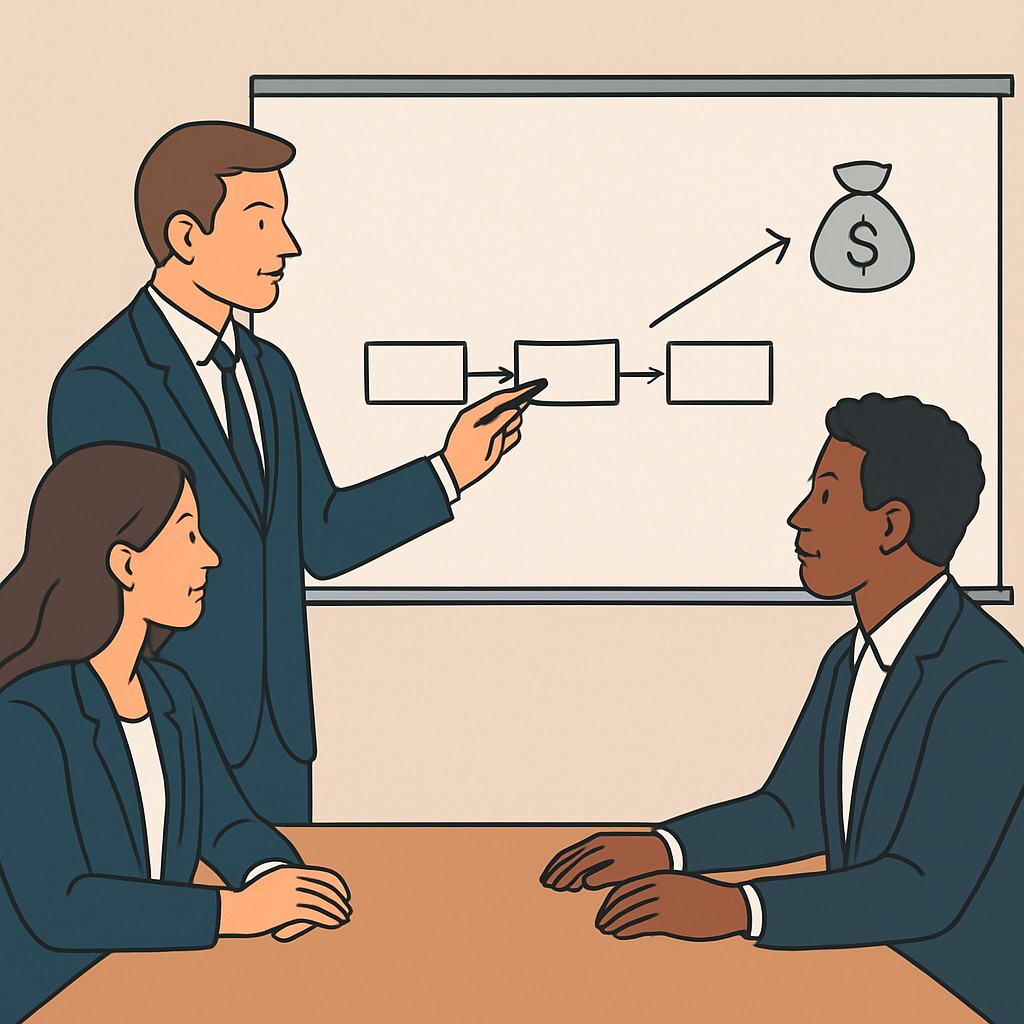
Align Roadmaps with Sales and Customer Success
This section complements earlier pricing and packaging work.
It aligns roadmap elements with sales and customer success.
It covers enablement, contract terms, SLAs, and negotiation playbooks.
Enablement for Revenue Conversations
Begin by creating value-focused enablement materials for sales and customer success.
Next, map demos to upcoming feature milestones and buyer scenarios.
Also, build objection-handling scripts tied to buyer priorities and feature claims.
Additionally, supply reusable collateral templates for proposals and negotiation conversations.
Finally, run regular roleplay sessions to rehearse messaging and close patterns.
- Value messages that connect features to buyer outcomes.
- Demo scripts that highlight monetizable capabilities and transition plans.
- Proposal templates that reflect entitlements and upgrade options.
Contract Terms That Reflect Roadmap Value
Structure contract terms to mirror feature availability and delivery expectations.
Define upgrade paths and change-order processes in clear language.
Align renewal incentives with adoption of roadmap features.
Clarify billing and entitlement boundaries for paid capabilities.
- Delivery timelines and acceptance criteria that match roadmap phases.
- Usage entitlements that prevent scope confusion during rollouts.
- Flexible amendment terms to enable commercial adjustments as features evolve.
Service Level Agreements and Measurable Outcomes
Tie SLAs to outcomes that buyers actually value.
Specify measurement methods and reporting cadence for transparency.
Include escalation paths and remediation steps for missed targets.
Set realistic metrics that reflect feature maturity and deployment scope.
Ensure internal teams commit to SLA delivery and monitoring.
Negotiation Playbooks for Feature Deals
Create playbooks that guide concessions, bundling, and approval paths.
Define standard concessions and acceptable tradeoffs for roadmap features.
Include value-based negotiation scripts for common buyer requests.
Codify approval thresholds and escalation points for special terms.
Train sales and customer success on applying playbooks during deals.
- Standard concession options linked to adoption milestones.
- Approval matrix that speeds up deal closures while protecting roadmap value.
- Templates for documenting negotiated feature commitments and delivery dates.
Gain More Insights: How to Handle Custom Requests Without Becoming a Dev Shop
Use Data and Feedback Loops to Iterate the Roadmap
Use continuous data.
Refine roadmap priorities with ongoing feedback.
Combine behavioral, revenue, and churn signals for balanced insights.
Collect and Centralize Signals
Centralize product usage, revenue attribution, and churn data into a single source.
Ensure teams can access the dataset without barriers.
Standardize event names and revenue tags across systems.
Capture qualitative feedback alongside quantitative metrics.
Interpret Usage Patterns
Analyze usage by behavior and feature engagement segments.
Identify features that drive repeat actions and workflows.
Use trend analysis to detect rising and declining engagement.
Surface usage anomalies that could indicate friction points.
Map Revenue Attribution to Product Work
Attribute revenue to specific features or workflows whenever possible.
Link feature adoption to observable revenue changes.
Validate roadmap bets using incremental revenue signals.
Prioritize items that show clear revenue lift signals.
Detect and Act on Churn Signals
Define behavioral indicators that typically precede churn events.
Instrument alerts for users showing at-risk patterns.
Trigger product changes or outreach when risk thresholds hit.
Track recovery rates after interventions to measure impact.
Close the Loop with Continuous Experiments
Design lightweight tests to validate signal-driven roadmap changes.
Measure outcomes with predefined success metrics and windows.
Iterate on features based on test results and feedback.
Document learnings to inform future roadmap choices.
Establish Governance and Cadence
Set regular review cycles to evaluate signal trends and roadmap items.
Invite cross-functional stakeholders to review evidence and trade-offs.
Record decisions and update the roadmap transparently for stakeholders.
Retain flexibility to reprioritize quickly when signal strength shifts.
Key Signals to Monitor
- Active usage per feature and user cohort.
- Feature-driven revenue contributions over time.
- Time-to-value metrics from first use to outcome.
- At-risk engagement indicators such as drop in frequency.
- Recovery and win-back success rates after interventions.
Communicate Roadmaps to Drive Purchase
Communicate roadmap value to accelerate buyer purchase decisions.
Highlight buyer outcomes rather than technical plans.
Use predictable updates to maintain buyer confidence.
Position Roadmap by Buyer Benefit
Focus messages on how features create clear buyer outcomes.
Emphasize measurable improvements that buyers value.
Avoid technical detail that does not link directly to buyer value.
Tailor benefit statements to each buyer segment.
Define Buyer-Focused Milestones
Translate roadmap items into milestones framed around buyer success.
Describe what buyers will gain at each milestone.
Set acceptance criteria that buyers recognize as clear success.
Use milestones as negotiation anchors in purchase discussions.
Set Clear Timelines and Manage Expectations
Communicate timelines in buyer-friendly windows rather than exact dates.
Indicate which milestones are high confidence and which are tentative.
Flag dependencies and risks that may affect delivery timing.
Keep update cadence predictable to build and maintain buyer confidence.
Provide Proofs and Validation
Pair roadmap promises with proof points buyers can verify independently.
Include buyer feedback and validation evidence when it exists.
Offer short demonstrations of incremental functionality where possible.
Present measurable indicators buyers can track after purchase.
Roadmap Presentation Formats for Buyers
Use concise formats that let buyers quickly scan upcoming value.
Link each deliverable clearly to buyer benefits in timelines.
Provide evidence and brief demos to show practical next steps.
- Create an executive summary that highlights buyer outcomes and priorities.
- Provide a milestone timeline that links deliverables to buyer benefits.
- Offer brief demos that showcase upcoming value in context.
- Include downloadable proof artifacts buyers can review offline.
Buyer-Focused Messaging and Demonstrations
Craft concise scripts that connect features directly to buyer goals.
Lead demonstrations with outcomes instead of technical details.
Adapt messaging to reflect the buyer persona in each meeting.
Next Steps for Purchase Conversations
Invite buyers to validate milestones during sales discussions.
Offer purchase options tied to milestone delivery and verification.
Capture buyer feedback to continuously refine roadmap messaging.
Additional Resources
Google search results for How to Create Feature Roadmaps Buyers Actually Pay For More General
Bing search results for How to Create Feature Roadmaps Buyers Actually Pay For More General